


- Contents
Customer Service Automation Solution Guide
Introduction to Customer Service Automation
The rapid increase in digital channels has led to more customer interactions, rising customer expectations, and a higher cost to serve. It's also become more difficult for businesses to understand customer needs across these channels and retrieve context from previous interactions, leading to a poor customer experience.
Customer service automation allows businesses to use automation and conversational AI (bots) to control the cost to serve and provide a personalized and contextual customer experience across voice and digital channels. It's about leveraging the right intervention on a customer's web journey at the right time and with the right technology. These technologies allow you to deliver a streamlined, personalized experience to your customers while reducing customer service costs. They allow you to identify which agent, bot, or combination of both best serves the customer and delivers better business outcomes.
Note: The Customer Service Automation Solution Guide doesn't provide detailed instructions for setting up, configuring, and deploying the automation components. For more information, see Appendix B: Resources.
Customer service automation helps to:
-
Increase self-service rates by using the right bots for the task
-
Improve agent routing accuracy through best-in-class intent and entity determination
-
Provide a more conversational and personalized experience
-
Speed up time to market through pre-built microapps
-
Reduce total cost of ownership through an intuitive business user interface
-
Improve resolution of customer issues, questions, or needs the first time, with no follow-up required (first call resolution)
-
Increase your Net Promoter Score
-
Reduce the number of interactions that an agent transfers to someone else for resolution.
Technologies
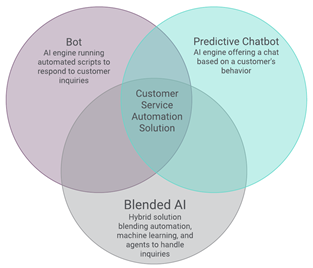
The following technologies are available for PureConnect on-premises and cloud customers:
-
Bots to handle tier one level questions, such as hours of operation or order status
-
Predictive chatbots to offer assistance at key interaction points, such as when a customer is struggling to complete a task
-
Blended AI to pass the interaction from a bot to a live agent, along with the context of the conversation
About bots
A bot is an AI engine that runs automated scripts to respond to messages received from a customer. Bots automate interactions to enhance the customer experience and provide basic answers, such as here’s your order and five things about it. Genesys supports a “design once, deploy anywhere” concept for bots to allow organizations to provide a seamless customer experience across voice and digital channels.
Bots support or orchestrate the following capabilities:
-
Personalization: Tailors the experience based on context from the current interaction or previous interactions.
-
Natural Language Understanding (NLU): Derives intents and entities. For example, it allows bots to extract meaning from what customers say to determine the contact reason (intent) and data (entities) such as dates, phone numbers, or amounts needed to process the interaction.
-
Identification and verification: Identifies and verifies the customer, if required.
-
Directed Dialog: Automates relevant business processes or provides information.
-
Other NLU/AI platforms, such as Amazon Lex, Microsoft bot framework, IBM Watson, or Google Dialogflow: Specializes in a specific topic.
-
Handoff to an agent: Connects the customer to a live person with the full context of the interaction.
About predictive chatbots
A predictive chatbot is an AI engine deciding whether to offer a chat based on a customer’s behavior. For example, the customer keeps cycling through certain webpages or is possibly leaving the website. The difference with Genesys Predictive Engagement and other predictive chatbots is that Genesys Predictive Engagement makes algorithmic choices about the right moment to offer a chat; as opposed to a website where every page displays a chat message asking whether the website visitor wants to speak to an agent. Based on the visitor's behavior on your website, the agent can say, for example, “It looks like you’re trying to schedule a Psychology class for your Nursing degree. I can help you with that.”
Genesys Predictive Engagement monitors website behavior in real time, applies machine learning to determine audience segments and predicted outcomes, and then uses that information to guide website visitors to a successful outcome. Genesys Predictive Engagement also uses historical data about website visits to make accurate predictions based on past behavioral patterns. Guidance starts with an effective self-service offer of a chatbot to those visitors who require assistance. Genesys Predictive Engagement allows you to unlock data in real time to engage customers proactively to eliminate the need for a voice call or contact without context.
About blended AI
Blended AI is the combination of automation, machine learning, and agents to handle customer inquiries on the customer's channel of choice. It allows you to seamlessly transition a customer from a bot to an agent with full context so that the customer doesn't have to repeat information. For example, the bot can transition the interaction to an agent when the customer has a complex question that the bot cannot answer or when an interaction is high value.