


- Contents
Status Aggregator Technical Reference
Introduction to Status Aggregator
The Status Aggregator Technical Reference is for system administrators and others who want to:
-
Understand the purpose, concepts, and architecture of the Status Aggregator.
-
Install and configure Status Aggregator on the Status Aggregator server.
-
Configure Interaction Administrator to work with Status Aggregator.
-
Import Status Aggregator security certificates into each CIC server.
-
Learn how to configure CIC clients to work with Status Aggregator.
CIC clients
Customer Interaction Center (CIC) supports two interaction management
client applications. CIC client
refers to either Interaction Connect
or Interaction Desktop.
What is a status?
Status Aggregator consolidates status information about CIC users. That information has three components:
- Status key
-
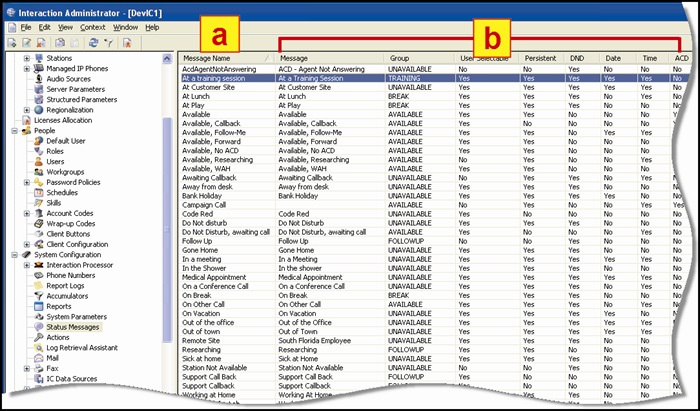
This key is a string value (Figure 1, a) that can be mapped to various attributes (b) specified in Interaction Administrator. It can correspond to a persistent status value (such as
Gone Home
orOn Vacation
) or a non-persistent value (such asFollow Up
). Persistent values are expected to survive across a server restart or user logout; non-persistent values are not. The status key may be accompanied by per-instance data, such asUntil
data indicating when the user expects to exit the status or a status detail string that can be displayed along with the user's status. On Phone
indication-
The
On Phone
indication is a Boolean value, which indicates whether the user has any active interactions on his or her user queue. If the user is logged into a station, this also includes interactions on his or her station queue. - CIC logon indication
-
The CIC logon indicator is a string value. If empty, it indicates that the user is not currently logged in to a CIC server. If non-empty, it specifies the name of the CIC server where the user resides.
These status values are displayed in various user-side displays and
are also used by various CIC subsystems (such as AcdServer). They are
also used to implement the Camp
feature that starts a call when
a camped-on user changes his/her status.
What is Status Aggregator?
Status Aggregator is a software subsystem that works with Customer Interaction Center. Status Aggregator allows users of the CIC clients to see the status not only of people in their own offices, but also in any remote office whose Customer Interaction Center server shares information with the Status Aggregator server.
Status Aggregator is intended for large organizations that have too many users to host on a single CIC server. Such organizations often have multiple sites and want to monitor employee or user status regardless of location. Status Aggregator makes users' status visible to all CIC servers that are connected to the Status Aggregator server.
What Status Aggregator does
Status Aggregator runs on a dedicated server. It consolidates status information about users residing on multiple CIC servers, whether in the same or in geographically separate offices. In turn, the Status Aggregator server makes this consolidated information available to all of the CIC servers.

Consolidated information flows from Status Aggregator to CIC servers to users.
The diagram shows a simplified example. In the diagram, each CIC server knows about its own users. CIC server 1, for example, knows about users 1–1,000. From the Active Directory server, CIC server 1 learns that users 1,001–2,000 are on some other CIC server, but does not have status information about those users. CIC server 1 can then go to the Status Aggregator server to obtain status information about those users if it is available. Users of CIC server 1 can then view status information about users who are logged in to CIC server 2.
Using a separate, dedicated Status Aggregator server solves the scalability problem that occurs when an organization has too many users to host on a single CIC server. When an organization wants to consolidate information about users from multiple CIC servers, the Status Aggregator server can scale up to the load and provide status information in real time.
Status Aggregator can work on a single Status Aggregator server or on multiple Status Aggregator servers to provide mirroring and fault tolerance. A single Status Aggregator server (or a single Status Aggregator server with a mirror server to provide nonstop operation if there is a problem) can:
-
Efficiently handle up to five CIC servers.
-
Efficiently handle up to 50,000 CIC users.
How Status Aggregator works
The Status Aggregator server:
-
Receives notifications of user status changes and caches them.
-
Receives queries for status values from client CIC servers.
-
Receives and manages requests to monitor for changes in the status of specific users.
The server does not try to map from one status type to another and does not proactively request status values from other CIC servers. It is by design a passive subsystem.
CIC servers receive status information from the Status Aggregator server.
Note: In order for Status Aggregator to include status information about a user, that user must have an associated email account matching his or her LDAP (or other data source) email account.
How Status Aggregator differs from Multi-site
The features of Status Aggregator overlap somewhat with CIC Multi-site, an optional software module that links together two or more CIC contact centers. However, the two products serve different purposes and are appropriate in different situations:
-
Status Aggregator is designed to provide status information, while Multi-site is designed to provide user mobility.
-
Status Aggregator consolidates status information from users on different CIC servers, while Multi-site links together CIC servers that all have the same set of users.
The following table compares the features of Status Aggregator to those of Multi-site.
| Feature | Status Aggregator | Multi-site |
|---|---|---|
|
Organization-wide directory |
Yes |
Yes |
|
Universal user extensions (users keep their usual telephone extensions when in remote offices) |
No |
Yes |
|
Real-time status |
Yes |
Yes |
|
Scalable. Each Status Aggregator server efficiently handles status information for over 50,000 users and over five CIC servers. |
Yes |
No |
|
Allows change of status |
No |
Yes |
|
Server |
Status Aggregator server. Must be on stand-alone server. |
RTM server. For 200 or fewer users, can be on any CIC server. For more than 200 users, must be on stand-alone server. |
|
Architecture |
SA Server + SA clients. Each Status Aggregator server gets information from all connected IC Servers. |
RTM server + CIC clients. Each RTM server gets information from the CIC servers that are in its collective. Each CIC server must include the EMSServer subsystem. |
|
Fault tolerance |
Two
or more Status Aggregator servers can be |
No fail-over backup between multiple RTM servers. |
For more information about Multi-Site, see CIC Multi-Site Technical Reference at https://help.genesys.com/cic/mergedProjects/wh_tr/desktop/multi_site_technical_reference.htm.
How Status Aggregator works with different CIC editions
Status Aggregator must be at the same version level as your CIC server.
How Status Aggregator uses security certificates
Status Aggregator uses security certificates to verify the identities of the Status Aggregator and CIC servers with which it exchanges status data. Using security certificates prevents unauthorized systems or individuals from intercepting or modifying the exchanged status data.
For more information about how Status Aggregator uses certificates, see Generate SSL Security Certificates and 3: Import Certificates Into Each CIC Server in this document. For background information about security and certificates, see the PureConnect Security Features Technical Reference at https://help.genesys.com/cic/mergedProjects/wh_tr/desktop/security_features.htm.