


- Contents
Interaction Recorder Technical Reference
Opus Dual-channel recordings
For Opus dual-channel recordings, the audio recording playback wave form displays the dual-channel audio as separate channels.
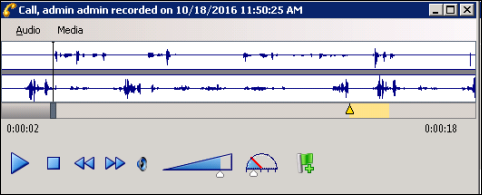
Left channel audio data is displayed in the top waveform, and Right channel audio data is displayed in the bottom waveform. The initiator of the call will always be on one of the channels, with all other participants on the audio call on the other channel. And the direction of the call will also determine which channel the participants and the initiator will be recorded on.
Important notes
-
Support for the playback and management of Opus recordings within the CIC Interaction Desktop, Interaction Web Portal, and IC Business Manager applications requires CIC 2017 R2, or later. Opus recordings can be generated within CIC and Interaction Recorder starting with Media Servers at version CIC 2017 R1, or later.
-
Support for Opus recordings within Interaction Recorder and CIC requires version 2017 R2 or later client and server-side components. Earlier versions of the Interaction Recorder Remote Content Servers also do not support Opus recordings and will result in errors when archiving or exporting Opus recordings. Opus recordings can be generated within CIC and Interaction Recorder starting with 2017 R1 or later Media Servers.
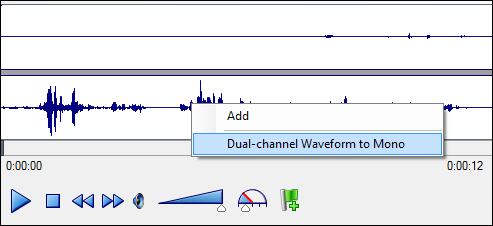
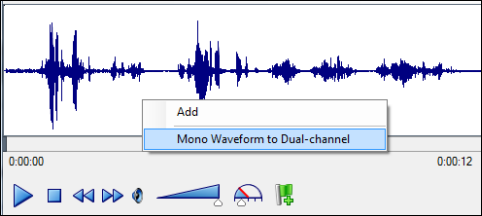
For dual-channel recordings, a right-click shortcut menu allows you to switch between dual-channel and mono waveform data during playback.
Dual-channel Waveform to Mono
Mono waveform to Dual-channel
Note
Enabling the Opus (Mono) and Opus (Dual-channel) compression formats requires
additional resources on the Media Servers. See the Interaction Media
Server Technical Reference and the Interaction Media Server Sizing
Calculator for details, specifically when using Dual-channel, as it requires
1 additional point on the Media Servers.
Enabling the Opus (Dual-channel) compression format requires additional
disk space storage. See Disk Space
Requirements for Compression Factors and Disk Space Requirements when
generating Opus (Mono) and Opus (dual-channel) recordings.