


- Contents
SNMP Technical Reference
Configure PureConnect SNMP service through the command line utility
Important!
You can configure SNMPv3 settings only through the PureConnect SNMP command line utility. For SNMPv2c settings, you can use either the PureConnect SNMP command line utilty or the SNMP Service Properties dialog box.
-
On the Windows server hosting a CIC product and the PureConnect SNMP service, open a command prompt window as administrator.
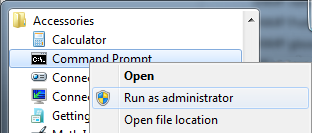
-
Use the cd command in the command prompt window to navigate to the ININ SNMP subdirectory:
CIC product Default PureConnect SNMP service directory Interaction Media Server
C:\Program Files (x86)\PureConnect\ININ SNMP
Interaction SIP Proxy
C:\Program Files (x86)\PureConnect\ININ SNMP
CIC server
D:\I3\IC\ININ SNMP\
Examples:
cd "C:\Program Files (x86)\PureConnect\ININ SNMP"
cd "D:\I3\IC\ININ SNMP"
-
Enter the following command and press the Enter key:
ininsnmpconfig-w32r.exe
The command prompt window displays the following output and changes the prompt to
ININ SNMP>.ININ SNMP Configuration Connecting to ININ SNMP...Connected ININ SNMP>
The
ININ SNMP>prompt indicates that the PureConnect SNMP service is in configuration mode.Tip:
You can enter h or ? at the
ININ SNMP>prompt and then press the Enter key to see a list of commands. -
At the
ININ SNMP>command prompt, configure the PureConnect SNMP service by entering the following command with the specified switches and necessary parameter values, and pressing the Enter key.ININ SNMP>setup --posture param1 --authmethod param2 --authpassword param3 --engineid param4- posture values
-
param1represents a secure configuration level- min
-
Configures outgoing messages to conform to SNMPv2c
Accepts incoming messages conforming to SNMPv1 (Not secure for incoming message but able to provide security for traps)
Deletes any previously defined SNMPv3 users for the PureConnect SNMP service
Creates a user identifier of
initialwith no privacy method or password (security level:authNoPriv)Sets the
snmpEngineIDto the specified valueSets
agent.defaultTraUsernametoinitialExample:
--posture min
- semi
-
Configures outgoing messages to conform to SNMPv3
Accepts incoming messages that conform to SNMPv3
Deletes all previously-defined users
Creates a user identity of
initialwith the specified authentication method and password, and the specified privacy method and password (security level:authPriv)Sets the
snmpEngineIDto the specified valueSets
agent.defaultTrapUsernametoinitialExample:
--posture semi
- very
-
Configures outgoing messages to conform to SNMPv3
Accepts incoming messages that conform to SNMPv3
Deletes all previously-defined users
Sets the snmpEngineID to the specified value
Note:
The very value does not create the user, initial. The PureConnect SNMP service will not accept any SNMP requests until you define and user and password.
Example:
--posture very
- authmethod values
-
param2 represents the user authentication method that the PureConnect SNMP service users for each SNMP message.
- none
-
No user authentication is done by the PureConnect SNMP service.
Example:
--authmethod none
- sha
-
The PureConnect SNMP service users the HMAC-SHA-96 (SHA) protocol to create a message digest with an algorithm. The authentication keys used by the service are generated locally with the Engine ID and the password of the defined SNMPv3 user.
Example:
--authmethod sha
- authpassword values
-
param3 represents a password that you enter for the defined SNMPv3 user. The PureConnect SNMP service uses this password for user authentication of SNMP messages.
Example:
--authpassword mypassword
- engineid values
-
param4 represents three components in a colon-separated string:
-
A number specifying an identifying method (IP address, MAC address, character string)
-
The Internet Assigned Numbers Authority (IANA)-assigned organization identifier
2793 is the IANA private enterprise identifer for
Interactive Intelligence
, which was acquired by Genesys. -
A value conforming to the specified method
- IPv4 address
-
1:IANA org number:4 octetsExample:
--engineid 1:2793:192.168.10.45
- IPv6 address
-
2:IANA org number:16 octetsExample:
--engineid 2:2793:2001:db8:3c4d:15::1a2f:1a2b
- MAC address
-
3:IANA org number:MAC addressExample:
--engineid 3:2793:782bcb8d6987
- Text
-
4:IANA org number:text(27 character maximum)Example:
--engineid 4:2793:thisisatest
- Octets
-
5:IANA org number:octets(27 character maximum)Example:
--engineid 5:2793:38a63b9d76df893a
-
After you press the Enter key, the command prompt window displays the following messages:
  Setting up ININ SNMP...
  Completed, ININ SNMP setup.
-
At the
ININ SNMP>command prompt, add an SNMP user by entering the following command with the specified switches and necessary parameter values, and then pressing the Enter key:ININ SNMP>au -uparam1 -a param2 --authpasword param3 -p param4 --privpassword param5- u (username) values
-
param1 represents the name of an SNMP user to add to the PureConnect SNMP service for SNMPv3 authentication.
Example:
-u johnsmith
- a (authmethod) values
-
param2 represents the user authentication method that the PureConnect SNMP service users for each SNMP message for this user.
- none
-
No user authentication is done by the PureConnect SNMP service.
- sha
-
The PureConnect SNMP service uses the HMAC-SHA-96 (SHA) protocol to create a message digest with an algorithm. The authentication keys used by the service are generated locally with the Engine ID and the password of the defined SNMPv3 user.
Example:
-a sha
- authpassword values
-
param3 represents a password that you enter for the defined SNMPv3 user. The PureConnect SNMP service users this password for user authentication of SNMP messages.
Example:
--authpassword mypassword
- p (privmethod) values
-
param4 represents the privacy protocol that the PureConnect SNMP service uses for this SNMP user.
- none
-
No privacy protocol is used.
Example:
-p none
- des
-
The PureConnect SNMP service uses the CBC-DES Symmetric Encryption Protocol for this SNMP user.
Example:
-p des
- aes128
-
The PureConnect SNMP service uses the Advanced Encryption Standard (AES) Cipher Algorithm for this SNMP user.
Example:
-p aes128
- privpassword values
-
param5 represents the password that the PureConnect SNMP service uses to generate keys with the specified privacy protocol for this SNMP user.
Note:
If you specify the privacy method (-p) as none, the --privpassword parameter is not required.
Example:
--privpassword mypassword
After you press the Enter key, the command prompt window displays the following messages:
Adding user
username
... Completed, user added.Tip:
To see a list of all users while using the PureConnect SNMP configuration tool, enter lu and then press the Enter key.
-
At the
ININ SNMP>prompt, add a trap destination by entering the following command with the specified switches and necessary parameter values, and pressing the Enter key:ININ SNMP> atd --community param1 --uri param2- community values
-
param1 represens a name that you define as an SNMP community identifier for SNMPv2c communications. This name is not used with SNMPv3 messages or authentication.
Supply a community name so that the PureConnect SNMP service can exchange message with multiple Network Management System (NMS) instances that support the range of SNMPv1, SNMPv2c, SNMPv3.
Example:
--community myexamplecommunity
- uri values
-
param2 represents a Uniform Resource Identifier (URI) destination, which is used for SNMP messages.
Note:
You can specify more separate destination URIs for differing protocols. For exaple, you can set the default URI as localhost and the SNMPv3 destination as username@myhost.com.
Tip:
Using the uri switch, you can specify additional information in the value, such as the SNMP user name and the network port to use.
- default
-
This value configures the PureConnect SNMP service to send all SNMP messages to the specified URI of an NMS.
If you use multiple SNMP agents that use differing versions (v1, v2c, v3), setting this value to the URI of an NMS that is capable of processing messages from all versions provides the simplest configuration.
Examples:
--uri default://mynms.example.com
--uri default://192.168.1.100
Note:
If you do not use the default value, the trap destination is not saved so that it appears in the Windows SNMP Service dialog box. The PureConnect SNMP service will save and use trap destinations that use values other than default but they are not displayed in the Widnows SNMP Service dialog box.
- snmp
-
At this time, this value is equivalent to using the default value in that it sends messages for all SNMP versions to the specified URI of an NMS.
Examples:
--uri snmp://mynms.example.com
--uri snmp://192.168.1.100
- snmpv1
-
This value configures the PureConnect SNMP service to send all SNMPv1 messages are sent to the specified URI of an NMS.
Examples:
--uri snmpv1://mynms1.example.com
--uri snmpv2://192.168.1.102
- snmpv2
-
This value configures the PureConnect SNMP service to send all SNMPv2c messages are sent to the specified URI of an NMS.
Examples:
--uri snmpv2://mynms.example.com
--uri snmpv2://192.168.1.102
- snmpv3
-
This value configures the PureConnect SNMP service to send all SNMPv3 messages are sent to the specified URI of an NMS.
You can specify an SNMP user and network port number as part of the URI in the following format:
snmpuser@uri:port
Examples:
--uri snmpv3://testuser@mynms3.example.com:8161
--uri snmpv3://192.168.1.103
Note:
You can add multiple trap destination URIs for each protocol version. For example, you can specify one SNMPv2c trap destination and five or more SNMPv3 trap destinations. To see a list of all defined trap destinations while using the PureConnect SNMP configuration tool, enter ltd at the ININ SNMP> prompt, and then press the Enter key.
-
At the
ININ SNMP>prompt, set a default user to associate with SNMPv3 traps by entering the following command and then pressing the Enter key:ININ SNMP>sdtu --username param1param1 represents an SNMP user that you have already added with the au -u username command in the PureConnect SNMP configuration tool.
After you press the Enter key, the command prompt window displays the following messages:
Setting the default trap user to
username
... Completed, default trap user changed. -
At the
ININ SNMP>prompt, add an accepted host for which the PureConnect SNMP service will receive and process SNMP messages by entering the following command with the specified switch and then pressing the Enter key:ININ SNMP>aah --host param1param1 represents the fully-qualified domain name (FQDN) or IP address of a host from which the PureConnect SNMP service will receive and process SNMP messages.
Tip:
You can add multiple hosts through a single aah command by adding multiple --host param switches.
Example:
aah --host 192.168.1.90 --host 192.168.1.91
After pressing the Enter key, the command prompt window displays the following messages:
  Adding the accept host(s)...
  Completed, host(s) added.
Tip:
You can list all defined accepted hosts by entering the lah command at the
ININ SNMP>prompt and then pressing the Enter key. -
If you need to set a minimum SNMP version that is acceptable to the PureConnect SNMP service, enter the following command with the specified switches and parameters and then press the Enter key:
Note:
This command is required only if you previously set the setup --posture command to a value of min. For the semi and very values, the PureConnect SNMP service automatically sets the accepted and outgoing SNMP version to 3.
ININ SNMP>smv --snmpversion param1param1 represents a single digit that corresponds to an SNMP version as defined in the following table:
1
SNMPv1
2
SNMPv2c
3
SNMPv3
The PureConnect SNMP service will accept SNMP messages for the specific version and any later version, if one exists.
After you press the Enter key, the command prompt window display the following messages:
  Setting the default accepted SNMP version to version-n (n)
  Completed, default accepted SNMP version changed.
-
If you need to set a minimum SNMP version that the PureConnect SNMP service is allowed to send, enter the following command with the specified switches and parameters and then press the Enter key:
Note:
This command is required only if you set the setup --posture command to a value of min. For the semi and very values, the ININ SNMP service automatically sets the accepted and outgoing SNMP version to 3.
ININ SNMP>sdv --snmpversion param1param1 represents a single digit that corresponds to an SNMP version as defined in the following table:
1
SNMPv1
2
SNMPv2c
3
SNMPv3
The PureConnect SNMP service will send SNMP that conform to the specific version and any later version, if one exists.
After you press the Enter key, the command prompt window displays the following messages:
  Setting the default outgoing SNMP version to version-n (n)...
  Completed, default outgoing SNMP version changed.
-
To check the status of the SNMP configuration, enter s at the
ININ SNMP>prompt and then press the Enter key.The command prompt window displays the following messages and the associated values (examples shown):
  Getting ININ SNMP status…
  Configured SNMP port: 161
  In use SNMP port: 161
  SNMP Port bind status: Both IPv4 and IPv6 ports successfully bound
  In packets: 523
  Out packets: 957
  Minimum accepted SNMP version: version-3 (3)
  Default outgoing SNMP version: version-3 (3)
  Default trap username: myexampleuser
-
To exit the ininsnmpconfig utility, enter x at the
ININ SNMP>prompt and then press the Enter key.
Note:
Ensure the Windows Firewall allows ports 161 and 162 for SNMP and traps to the Network Management Servers that you specified as trap destinations.