


- Contents
Virtualization Technical Reference
Networking issues
Another potential problem with virtualization on Hyper-V is the inability of the host to provide a stable and reliable network layer to the guest. RTP packets that carry audio and voice over IP networks are extremely sensitive to latency. Advanced mechanisms in the Interaction Media Server can compensate for some loss and delay, but it has limits to the improvements that it makes.
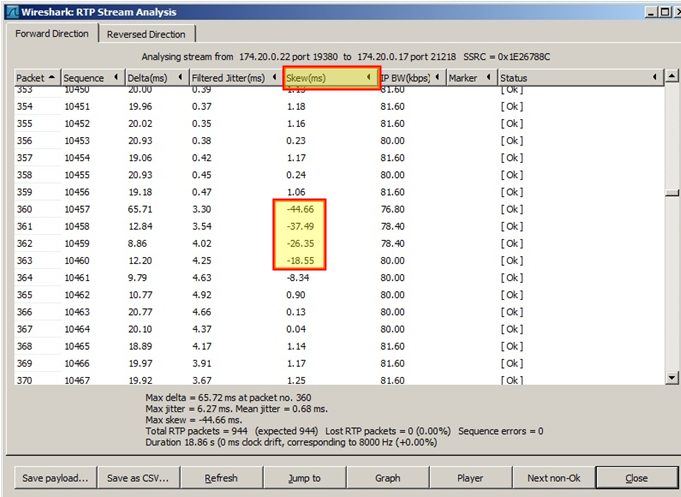
When an Interaction Media Server records calls, it temporarily stores recordings locally before moving them to an Interaction Recorder Remote Content Service (RCS) system or Interaction Recorder. The following image displays how jitter was introduced when Interaction Media Server transmits compressed RTP recordings. In lab tests, the network layer starts to fail when RTP approaches the 120 Mbps level. Dedicated NICs do not help to alleviate this problem on Hyper-V hosts.
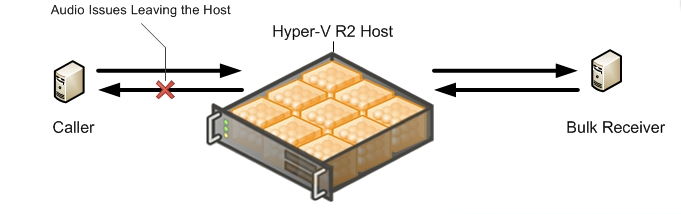
The following image indicates that the sent (transmit) "leg" is usually the first to have quality problems. This problem is a result of the variability of the data transfer of recordings with RTP streams from Interaction Media Server to another network storage location. The receive (sent) "leg" only has RTP steams coming into Interaction Media Server, but the problem will occur after a longer period of time. For this reason, it is important to evaluate both sides of the RTP steaming channels.
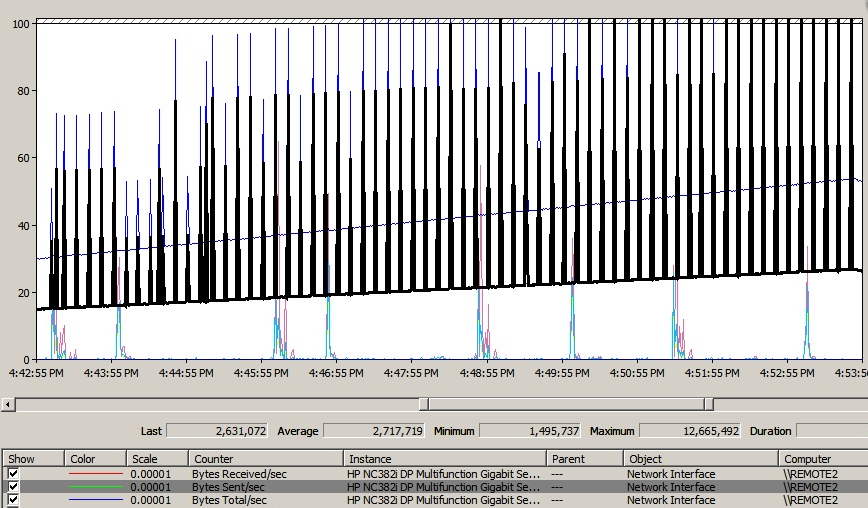
However, usage of virtual Receive Side Scaling (vRSS) in Hyper-V guests significantly improves network performance for an Interaction Media Server.